Al-Quran: Juz' 1 (Al Fatiha 1-Al Baqarah 141) with English translation from the Noble Qur'an.
Tuesday, July 1, 2014
Al-Quran: Juz' 1 (Al Fatiha 1-Al Baqarah 141)
Al-Quran: Juz' 1 (Al Fatiha 1-Al Baqarah 141) with English translation from the Noble Qur'an.

Wednesday, June 25, 2014
A Woman of God
بسم الله الرحمان الرحيم
In the Name of Allah,
In the Name of Allah,
the Most Gracious, the Most Merciful
 In the past week or so, I have had a number of mini-revelations
about myself that has led to an ultimate one: I want to be a woman of Allah. A woman of God.
What does that mean?
For me, and at this point in my life, it means that I want to live for my Creator (and He is free of all need). Why? Because up until now, everything else that I have lived for has brought me some type of misery.
I have lived for the material world and found myself both over and underwhelmed by the facade that exists behind its attractive exterior.
I have lived for people and been betrayed, let down, hurt, taken advantage of, neglected, under-appreciated and belittled.
I have lived for attention and the sake of pleasing those around me, only to be left feeling unlovable, never good enough, and unable to be everything for everyone.
I have lived for my emotions only to become intoxicated and disillusioned by both fleeting moments of perceived happiness, and horrifying depths of despair and darkness.
I have lived for my lowly, base, and carnal desires only to feel ashamed at my lack of self-control, determination, and will-power.
I have finally come to understand that living for the sake of anything except Allah, subhanahu wa ta’ala (exalted is He), will never fill the many voids that reside in my heart and instead, only create more. I have come to realize that I was attempting to medicate with poison; that I was stubbornly trying to fill a hole in my heart with things that would – and could – never complete me. With the temporary. The finite.
And yet, at the very realization that my heart could only be filled with the infinite love, remembrance, compassion, mercy, and blessings that come only from my Lord, my heart began to swell as the voids were steadily filled.
Reading these words may lead you to believe that I have reached some metaphorical illumination or level of enlightenment. But the truth is, I say these words knowing very well that I am a sinner. That I self-sabotage on my journey to Him by constantly disobeying His commands and neglecting my duties towards Him. I say these words as someone who has acknowledged their short comings, and who seeks to better themselves in whatever capacity they can. I say this as someone who is slowly, but surely, on a journey to self-realization, acceptance, and (insha’Allah) true love.
I say this as a young woman living in a world that she does not truly feel she belongs in. As a young woman searching for the divine while attempting to make peace with herself and her demons. As a young woman who has looked for love in the wrong corners and has now turned to the very source of it. No, not turned, but ran. Sprinted. For this transformation that she has felt herself undergoing is one of urgency, driven by the lack of satisfaction with the dunya (this life), devils, and desires.
It’s funny because when we think of a person of God, a certain caricature pops into our minds – typically someone who embodies humanity’s ideals of upright character, morals, and ethics: a monk, or ascetic. Someone who has completely given up the world and what it contains.
However, I do not fit this caricature whatsoever. In fact, none of us do. Which is why, and beautifully so, that a person of God may be recognizable only to God Himself. To the rest of the world, they may simply be “so and so”. But to Allah (swt), they may be someone who has attained His mercy, nearness, and blessings; His love and guidance and pleasure.
Becoming a woman of God, for me, ultimately means establishing a connection to my Creator so strong, that nothing – no circumstance, person, material, mood, or ideology – can come between us. It means that I seek my ultimate counsel, friendship, nearness, love, hope, trust, fear, companionship, acceptance, and reliance from Him first and foremost. Being a woman of God means that I have taken the following hadith to heart and strive to become the one about whom Allah (swt) says:
“When I love [them] I am [their] hearing with which [they] hear, [their] seeing with which [they] see, [their] hand with which [they] strike and [their] foot with which [they] walk.” (Bukhari)1
It also means that my empowerment comes from Him alone. Not society, fashion, billboards, magazines, or false, unattainable standards. But from the One who is the Most Just. From the One who will accept me regardless of my appearance or flaws. From the One who will look at my heart and judge of its soundness and sincerity.
As whimsical, far-reached, unattainable or even pretentious as it sounds, this is what I ultimately want for myself. To become a woman of God. To give my whole heart, the entire fabric of my being, the intricacies of my essence and the fibers of my soul to Him, and Him alone.
May He make it possible for me, and you as well – Ameen.
And Allah (swt) knows best.
To read the Original post click here
Saturday, June 14, 2014
Aiming for an Awesome Ramadhan
بسم الله الرحمان الرحيم
In the Name of Allah,
the Most Gracious, the Most Merciful.
![[Aiming for an Awesome Ramadan Series - Part 4] Awesome Duas For an Awesome Year - Productive Muslim](https://blogger.googleusercontent.com/img/proxy/AVvXsEgmsMGbGhT1N5IESzXS8-HwBLkvDqzMu6mkUfUvPxs8-dolYsAPp5H87VeB8jKZZgtbK_31VyYbSN75iQflAGonqcB93JdY8CFTsDOT_aehSlJwaygtB0pR5Dp1kwY2qyUJHUNKNWaJGkeN215uCVwUzSOApEBXShwQS7Hw7PCx7gTyssL1l8dvZ6mYpDw4WkH6-saEVXoAhItWkB5r2pZXoWC4EbGLen4mnbWLKJM9bgPU2YX0q5mZ8ccZ1WAv_Hg=s0-d-e1-ft)
In the Name of Allah,
the Most Gracious, the Most Merciful.
Some believe Ramadan is special simply
because it contains a night that is greater than 1,000 months, but what
makes that night so great? The truth is, during that night the qadar
(decree) for the coming year is sent down from the preserved tablet. As
Allah  says what can be translated as: “On that night is made distinct every precise matter” [Qur'an: Chapter 44, Verse 4], and more famously: “The angels and the Spirit descend therein by permission of their Lord for every matter.” [Qur'an: Chapter 97, Verse 4].
says what can be translated as: “On that night is made distinct every precise matter” [Qur'an: Chapter 44, Verse 4], and more famously: “The angels and the Spirit descend therein by permission of their Lord for every matter.” [Qur'an: Chapter 97, Verse 4].
Did you know that there is something you can do to change that qadar in its vulnerable state as it descends from the heavens?
Yes, it is the power of dua! As the Prophet  mentioned: “Nothing could change the Qadar except dua” [Sahih al-Jami'].
mentioned: “Nothing could change the Qadar except dua” [Sahih al-Jami'].
And in another hadith, he said: “Dua
benefits in the things that have happened as well as the things that
have not happened yet. The calamity comes down, but the Dua confronts it
and they may continuously wrestle until the Day of Resurrection” [Reported by Al-Hakim].
said: “Dua
benefits in the things that have happened as well as the things that
have not happened yet. The calamity comes down, but the Dua confronts it
and they may continuously wrestle until the Day of Resurrection” [Reported by Al-Hakim].
This makes the month of Ramadan and especially the last ten nights, an exceptionally powerful time to make dua [Sunan Ibn Majah].
As we aim for a remarkably productive
Ramadan, In sha Allah, it makes sense for us to prepare with
deliberation and careful thought the duas we will focus on throughout
the month. So ask yourself: “What are the duas that will change my life
in the coming year?” and be absolutely certain that Allah will answer them In sha Allah! In the rest of this article, I will share my best tips for preparing these duas.
will answer them In sha Allah! In the rest of this article, I will share my best tips for preparing these duas.The 8 Duas You Must Make This Ramadan
Every Ramadan for the past several years, I
decide in advance which eight duas I will focus on. I pick two duas
from each of the four categories listed below. Why 8? Most masjids pray 8
raka’ahs of taraweeh (at least), so I repeat only one dua consistently
in each raka’ah of taraweeh (during sujood, etc.). That way, I always
remember which raka’ah I am on, which helps me focus and stay alert
during the late night taraweeh of these long summer days. It doesn’t
need to be specifically 8 duas, though. It could be 17 — one for every
raka’ah in the fardh salah — for example, but since we are talking about
Ramadan (and it is easier to remember 8 than 17) let’s just stick to
the 8.
There is something more important than the
number, and that is the effort you put in. Imagine the dedication and
consistency you are showing to Allah
by making the same duas every night for 29 or 30 nights throughout each
raka’ah of taraweeh! In addition, if you are indeed that consistent,
you will surely catch Laylatul Qadr! You would be displaying a level of dedication that few do: showing to Allah that you are desperate for His help. How could He possibly turn you away empty-handed?
by making the same duas every night for 29 or 30 nights throughout each
raka’ah of taraweeh! In addition, if you are indeed that consistent,
you will surely catch Laylatul Qadr! You would be displaying a level of dedication that few do: showing to Allah that you are desperate for His help. How could He possibly turn you away empty-handed?
The more thought you put into this
activity, the better. However, be careful not to over think it. It is
possible to complete the activity in five minutes if you are pressed for
time, so complete it as quickly as you can.
Note that this list of dua does not necessarily need to match the goals we discussed in the previous articles [Part 2 | Part 3], as they are goals for Ramadan. The dua list you are creating now is for your life in general.
While there is no guarantee your dua will
come true, you must pray as if it will. Your dua might avert a calamity,
an illness or some other difficulty that was destined for you, so in
that sense your dua would still be answered and accepted without
necessarily coming true. We never truly know what is best for us, but
Allah certainly does — and He always delivers [Qur’an: Chapter 2, Verse 216].
certainly does — and He always delivers [Qur’an: Chapter 2, Verse 216].The Four Categories
1. Deen: Since Ramadan is all about taqwa and improvement, pray and beg Allah to improve you. Pick two aspects of your deen that you would like to improve and pray earnestly that Allah
helps you with them. Maybe you have not done hajj or umrah yet? Make
dua that you can do so before next Ramadan! Does that sound ridiculous?
It is not difficult for Allah ! Want to memorize the whole Qur’an? Or part of it? It is easy for Allah . Want to shed a bad habit? Or build a new one like praying in the masjid? This is your chance to ask Allah to your heart’s content!
to improve you. Pick two aspects of your deen that you would like to improve and pray earnestly that Allah
helps you with them. Maybe you have not done hajj or umrah yet? Make
dua that you can do so before next Ramadan! Does that sound ridiculous?
It is not difficult for Allah ! Want to memorize the whole Qur’an? Or part of it? It is easy for Allah . Want to shed a bad habit? Or build a new one like praying in the masjid? This is your chance to ask Allah to your heart’s content!
2. Dunya: One of the first dua we come across during taraweeh is “rabbana aatina fil dunya hasanah” or “Our Lord, give us in this world [that which is] good…” [Qur’an: Chapter 2, Verse 201]. Allah
teaches us to pray for the life of this world. That sounds good to me.
As long as I am here, I want to get as much out of it as I can! So ask
for Allah’s help from the bottom of your heart. Do you need help with marriage? Job? House? Car? Health? This is the time to ask Allah without limiting His ability .
teaches us to pray for the life of this world. That sounds good to me.
As long as I am here, I want to get as much out of it as I can! So ask
for Allah’s help from the bottom of your heart. Do you need help with marriage? Job? House? Car? Health? This is the time to ask Allah without limiting His ability .
3. Akhira: The next part of that dua is “wafee al akhirati hasanah” – ” … and in the Hereafter [that which is] good …”
Since our ultimate destination is the next life, we ought to dedicate
part of our prayers to having an enjoyable afterlife too! Note: putting
the dua in this order does not mean one is more important than the
other, but you knew that. I personally like to pray for some specific
aspect of Paradise and for protection from Hellfire. Do you want to sit
with the Prophet in Paradise? Or maybe see and speak to your Creator ? Is there an aspect of Hellfire that you find particularly terrifying? Seek Allah’s protection from it.
in Paradise? Or maybe see and speak to your Creator ? Is there an aspect of Hellfire that you find particularly terrifying? Seek Allah’s protection from it.
4. Others: Ramadan is not a time to be selfish. This is why Allah
requires us to give zakat al-fitr and helps us unite our community
during taraweeh and Eid. So when you are planning your dua for Ramadan,
it is critical you remember others. There are so many causes, so many
people going through difficulty: Make a conscious effort to keep their
plight on your mind. Think of your family and friends, the community and
our ummah at large. By praying for them, we will also get the added
blessings of having the angels say ‘ameen’ to those duas and praying for
us as well. [Sunan Abi Dawud]
requires us to give zakat al-fitr and helps us unite our community
during taraweeh and Eid. So when you are planning your dua for Ramadan,
it is critical you remember others. There are so many causes, so many
people going through difficulty: Make a conscious effort to keep their
plight on your mind. Think of your family and friends, the community and
our ummah at large. By praying for them, we will also get the added
blessings of having the angels say ‘ameen’ to those duas and praying for
us as well. [Sunan Abi Dawud]
With so much to pray for, how do you
possibly select only two duas per category? Again, try to make your list
as simple and comprehensive as possible. And remember, you can always
make more duas outside this list!
Action Steps
- Write down your 8 duas on this worksheet along with your Ramadan goals and keep them in your pocket or wallet at all times.
- If you are the digital type, put them in your note-taking app or create an image of both lists and put the image as the background for your smart phone and computer’s desktop as a consistent reminder.
- Refer to this document/image every day, especially between taraweeh prayers.
Now, please share with us your thoughts on this action plan, and what dua you recommend for your brothers and sisters.
Saturday, May 3, 2014
Securing Rewards in Marriage
بسم الله الرحمان الرحيم
In the Name of Allah
the Most Gracious, the Most Merciful

by Hazrat Maulana Yunus Patel Sahebرحمة الله عليه
The sawaab (reward) for the sabr (patience) a woman exercises over her difficulties in managing the home
of her husband and fulfilling the rights of her husband and children sometimes is such, which makes her ‘reach’ Allah Ta’ala very quickly. This, however, is conditional to her obedience to Allah Ta’ala; fulfilling
His Rights, the Rights of His Rasul صلى الله عليه وسلم, as well as the Rights of His Creation.
Women who have a number of children, sometimes even a temperamental husband, together with many household chores and other responsibilities sometimes think that they cannot achieve the ranks of the
Auliya Allah[1] because they do not have time for ‘wazeefas’[2] and Nawaafil (optional prayers).
I tell them that they need not worry about too many wazeefas. The most important ‘wazeefa’ is abstinence from all sins. Added to this they should just correct their niyyah or intention in all that they
are doing as routine housework. Make the intention of pleasing Allah Ta’ala, then that same housework becomes Ibaadah. In this simple way, they will easily secure great rewards and the same spiritual stages,
if not higher.
Similarly, the sawaab for the sabr (patience) a man exercises over his wife’s shortcomings, emotional outbursts or mood swings is a medium by which he too acquires great rewards and reaches Allah Ta’ala very, very quickly.
Many Auliyaa Allah reached great spiritual heights, and were accepted for tremendous service to Deen
on the patience they adopted with their wives, and on the love, care, affection, tenderness and generosity they also extended to their wives.
Rasulullahصلى الله عليه وسلم set the perfect example for husbands. Despite the tremendous responsibilities
that he was entrusted with, he gave due attention and time to his wives and treated them with love and generosity. He was never harsh or insensitive towards any single wife.
Rasulullahصلى الله عليه وسلم also said: “The best amongst the Believers is he is whose character is
the best. And the best among you is the one who is best towards his wife.”
[1] Auliya Allah : Friends of Allah Ta’ala
[2] Wazeefas : additional, optional supplications
Click here to read the original post
Monday, April 7, 2014
Tips to Effectively Discipline Your Children
بسم الله الرحمان الرحيم
In the Name of Allah,
the Most Gracious, the Most Merciful.
![[Family Life - Part 3] Tips to Effectively Discipline Your Children | Productive Muslim](https://lh3.googleusercontent.com/blogger_img_proxy/AEn0k_sA3e_639cu4Fy83Gl4BPipka7tb2DiDu7L6FTYCiW4LEgk6TPRzIqc-t5zem4Kt9_cY9nRfwnhbL87hlZcyuEuGRfBMRZd1_8--TjfYTFqsdj2YehwTnUCx9RYmn3g2aO92npfnAkWRmLDbBy6qFmgSJq6PEm5n46W5ybhs26UYLzTo_KVQ2pBr5xMEzLfJvEylti00UxawzkouUK2m_QJR0ZCpd2g1naMKRZ_pJL4eUiKlIOHO5o=s0-d "[Family Life - Part 3] Tips to Effectively Discipline Your Children | Productive Muslim")
Photo by Tiffany Jill: iquitcountingstock[dot]deviantart[dot]com
This is the third and final piece of a 3-part series on having a productive household. In this section, we will discuss 7 more aspects of a productive household. These will relate to successful ways of disciplining your children more effectively without hitting or shouting.
In the Name of Allah,
the Most Gracious, the Most Merciful.
Photo by Tiffany Jill: iquitcountingstock[dot]deviantart[dot]com
This is the third and final piece of a 3-part series on having a productive household. In this section, we will discuss 7 more aspects of a productive household. These will relate to successful ways of disciplining your children more effectively without hitting or shouting.
1. Be Sensitive to Your Child’s Feelings
One of the best ways to avoid future
behavioural problems is to be sensitive to your child’s feelings. Let
your child know you understand how he feels, even when he has
misbehaved. For example, If Abdullah comes home with a notice from
school that admonishes him for speaking disrespectfully to his teacher,
listen to his story and frustrations first. Let him know that you understand how he feels. Then
later you can kindly follow up with instructions on how he should
handle the situation in the future more appropriately. At this time, you
can also proceed to dispense whatever penalties you deem suitable.
The most effective penalties are those that are implemented with respect and gentleness. Allah says in Qur’an: “So
by mercy from Allah, [O Muhammad], you were lenient with them. And if
you had been rude [in speech] and harsh in heart, they would have
disbanded from about you. So pardon them and ask forgiveness for them
and consult them in the matter.” [Qur’an: Chapter 3, Verse 159]
says in Qur’an: “So
by mercy from Allah, [O Muhammad], you were lenient with them. And if
you had been rude [in speech] and harsh in heart, they would have
disbanded from about you. So pardon them and ask forgiveness for them
and consult them in the matter.” [Qur’an: Chapter 3, Verse 159]
According to hadith, the Prophet said: “Whoever
was given his share of gentleness, then he has been given a share of
good. And whoever has been prevented from his share of gentleness, then
he has been prevented from his share of good.” [Tirmidhi]
said: “Whoever
was given his share of gentleness, then he has been given a share of
good. And whoever has been prevented from his share of gentleness, then
he has been prevented from his share of good.” [Tirmidhi]2. Use Positive Reinforcement Often
Seek out situations and behaviours in
which you can commend your child. For example, when you notice Abdullah
getting along with his younger sibling or completing his homework
without being told, let him know how pleased you are. Such as,
“Abdullah, thank you for cleaning your room without my reminding you to.
Your room looks really nice.”
You will often find that encouragement leads to more successful discipline than criticism. Encouragement
makes people feel good about themselves, which leads to further effort.
Criticism, on the other hand, leads to feelings of despondency, which
results in apathy.
3. Give Your Child Control Periodically
We all have a need to be in control of our
lives and to feel important. If you find your child becoming
increasingly combative and argumentative, give them a say in what goes
on in the house. Make sure you provide your children with the
opportunity to make their own decisions every now and then. Also, allow
them to be in charge of things around the house. For children who have a
stronger desire to be in control than others, grant them the extra
responsibility. Consider assigning daily chores to your children. This
can give them a sense of belonging and purpose. Use an incentive chart
to encourage them to complete their chores on occasions they are
reticent.
If your child refuses to take a bath when asked to, try offering him or her options rather than commands. For
example, “Abdullah, do you want to take your bath now or in ten
minutes?” Occasionally, let your child decide what dinner will be for
the night or where the family should go for their weekend outing.
4. Be Fair When Disciplining
Being unfair or excessively harsh when
correcting your child can sometimes lead to your child retaliating in
subtle ways, such as venting his anger on younger siblings or
embarrassing you in front of friends and family with disruptive
behaviour.
According to hadith, the Prophet said: “Treat your children fairly, treat your children fairly.” [Nasa’i]
said: “Treat your children fairly, treat your children fairly.” [Nasa’i]
Another hadith states that the Prophet said: “Act equally between your children; Act equally between your sons.” [Abu Dawud]
said: “Act equally between your children; Act equally between your sons.” [Abu Dawud]
Everyone wants to feel respected and
appreciated. Treating your children justly can alleviate a host of
discipline problems and helps to make them feel valued. A person who
feels valued has the self-respect to adhere to established rules.
If you find you have disciplined excessively or unjustly, let your child know you are sorry. Parents can apologise too. This
can teach your child that mistakes in judgment can be corrected. It can
also help your child to swallow his resentful feelings that lead to
excessively unruly behaviour.
5. Be Conscious of Your Stress Level
If you have been under extra stress lately,
realise that your frustrations with your child might be related more to
how you are feeling rather than your child’s actual misbehaviour. When you are under added stress, you tend to have less patience. You
might snap at your children for things you would not ordinarily scold
them about. During these periods, acknowledge your heightened tension
and then decrease your stress by retreating to your room for rest. You
can also relax by involving yourself in special personal time such as
reading an enjoyable book or listening to Qur’an.
6. Be Aware of Your Child’s Stress Level
A child that is stressed out is less
likely to be cooperative and more inclined to moodiness. Both of these
actions can lead to problem behaviours. If you notice that your child is
experiencing added stress, focus on relieving the stress by determining
what is upsetting him or her and doing what you can to help alleviate
the problems. During these stressful periods, within reason, try to
overlook negligible behaviours. Focus more on finding solutions rather than punishment.
Also, keep in mind that one of the best ways of alleviating your child’s stress level is by showing your love and affection.
According to hadith, the Prophet was very loving with his grandchildren. Aisha  reported, “Some Bedouin people came to the Prophet and said: ‘Do you kiss your children?’ He said: ‘Yes’. He said: ‘But we, by Allah, never kiss (our children)’. The Prophet said: ‘What can I do if Allah has taken away mercy from you?’” [Ibn Majah]
was very loving with his grandchildren. Aisha reported, “Some Bedouin people came to the Prophet and said: ‘Do you kiss your children?’ He said: ‘Yes’. He said: ‘But we, by Allah, never kiss (our children)’. The Prophet said: ‘What can I do if Allah has taken away mercy from you?’” [Ibn Majah]7. Determine if Your Child is Seeking Attention
Some children will attempt to seek
attention in any way they can, even if it is through improper behaviour.
Try to spend more time with your child if you know you have been a bit
slack lately. Simply listening more and giving your full attention when he or she is talking to you can be a start. But
also remember to put aside special time during the day or week to spend
with your child. Make it a habit of playing games every Friday or going on outings every Saturday. Arrange a schedule that will be suitable for all family members.
The Prophet was known to spend fun time with his family. According to hadith, Aisha said that while she was on a journey along with the Messenger of Allah , “I
had a race with him (the Prophet ) and I outstripped him on my feet.
When I became fleshy, (again) I had a race with him (the Prophet) and he
outstripped me. He said: This is for that outstripping.” [Abu Dawud]
was known to spend fun time with his family. According to hadith, Aisha said that while she was on a journey along with the Messenger of Allah , “I
had a race with him (the Prophet ) and I outstripped him on my feet.
When I became fleshy, (again) I had a race with him (the Prophet) and he
outstripped me. He said: This is for that outstripping.” [Abu Dawud]
Establishing effective discipline
techniques in your home can help parents achieve one of the most
difficult yet most critical roles of a parent — that of the proper
training of their children and in turn, a productive household.
Developing a productive household is an
important aspect of establishing a healthy and productive society. Begin
striving to improve your household habits in the manner mentioned in
the three parts of this series. Be generous and kind, be patient with
shortcomings, be committed to an intact family, and most important of
all, remain faithful and dedicated to pleasing Your Lord. In sha Allah,
you will see a more positive and fruitful home in the future.
If these tips have helped or if you have some more tips to share, let us know in the comments below!
About the Author:
Grandma Jeddah
is the mother of 11 children and 10 grandchildren. She has taught at an
Islamic School in Los Angeles, California for over thirty years. She is
the author of Discipline without Disrespecting: Discover the Hidden Secrets of How to Effectively Discipline Your Muslim Child– And Keep Your Peace of Mind While at It. To order her e-book or subscribe to her free newsletter, visit her website at: www.grandmajeddah.com
Click here to read the original post
Tuesday, January 14, 2014
Wednesday, December 25, 2013
Wednesday, December 4, 2013
Monday, November 4, 2013
Wednesday, October 16, 2013
Friday, October 11, 2013
Friday, September 6, 2013
The Forgotten Blessing: Giving Your Parents the Proper Treatment They Deserve
بسم الله الرحمان الرحيم
In the Name of Allah,
the Most Gracious, the Most Merciful.
Striving Muslimah

“Ali, please come downstairs and eat”, calls Haleema, his mother, for the third time. “In a minute MUM, I’m busy, you’re so difficult.. gosh.. just leave me alone!” followed with a loud slam of the door.
How many of us are guilty of this? It may not be the exact same words, but in some way we have all disrespected our parents, which they certainly do not deserve. Today’s youth have lost respect for their parents who worked so hard to raise them. It has become the “norm” to scream at our mothers. We make derogatory remarks and sometimes pretend like we cannot hear what they’re saying.
Just take a second to step back and reflect: the one who taught you how to walk, eat, speak – you consciously CHOOSE to ignore her?
Yet a mother’s unconditional love is like no other. No matter what her daughter or son says, she will call again. Do you know why? Not because she’s your enemy and out to “get you” or because she’s purposely trying to annoy you. It’s because she genuinely cares. She cares a whole lot, more than anyone will ever care.
When you were younger, she went hungry so you could have a full stomach. She didn’t buy anything for herself so she could spend on your toys, just to see you smile. She nursed you when you were ill, she took every blame for you to hide your faults. So why do you suddenly act like YOU are doing HER a favour by just standing in her existence? Seriously, are you for real?
Paradise is at the Feet of Mothers
You should instead be treating her like a queen and “kiss the very ground she walks on” for all the favours she’s done for you.
Subhan Allah – I don’t want to sugarcoat the reality because I’ve seen this happen with my own eyes, so don’t take offence to what I say. Unfortunately the truth is more bitter than it’s ever been. I’ve witnessed it – the endless worry and care of mothers for their children and the children’s utter disrespect and disregard for their mothers because, “It’s different now!” and “Ugh, you’ll never understand me”.
Why? Because they were never young so they obviously won’t “get you”?
This injustice is done not only to mothers but fathers too. Sometimes children become so arrogant and enveloped in their selfishness that when their parents speak to them in their native language they cleverly reply with English slang terms in attempt to humiliate their parents. I ask you today to contemplate on this. With the high status Allah (glorified and exalted be He) has given to our parents, do we even pay them an ounce of the value they are worthy of?
Here’s What You Need to Stop Doing
Stop raising your voice
“Say not to them [so much as], ‘uff,’” [Qur'an: Chapter 17, Verse 23]. What a profound statement from the Qur’an. We should not even sigh heavily, let alone raise our voices. When your parents raise their voice at you, 9 out of 10 times they have a very good reason to do so. Don’t let shaytan fuel your anger and ego, causing you to react totally inappropriately. Stop, listen, agree and apologise – thereafter rectify your mistake, even if you think you’re right and they’re being unjust.
Stop ignoring them
So you’re out with your friends and suddenly you see a call from “Home”. Automatically you dismiss the call. Why? Don’t want to disturb the good time you’re having with your friends, or are you embarrassed to speak to your mum and dad?Remember when you were five years old, and you decided to throw a tantrum in the middle of a supermarket? Don’t you think you embarrassed your mum then? She didn’t decide to abandon you, did she? Because at the end of the day, you’re her child and no matter what you do, she will never ever be embarrassed of you. You owe a hell of a lot to your parents.So pick up that call, and politely answer their questions. Better yet, call them a few times while you’re out. It won’t kill you – you have countless minutes to spend on your friends. So spare a few minutes on your parents and spare them imagining all sorts of horrific scenarios in their minds when you don’t pick up!
Stop thinking you’re always right
This, for me, is one of the most loathed characteristics. Think about it logically – how much worldly experience do your parents have compared to you? Making sense yet? When discussing things with parents, remember never to reject their opinions. Believe it or not, they were young once and also made mistakes, probably the same mistake you’re about to make now, which is why they are advising against it.As the Romanian proverb goes, “Only the foolish learn from experience; the wise learn from the experience of others.” So take advantage of their knowledge, experience and wisdom that you haven’t developed yet. So next time, instead of rolling your eyes and saying, “Yeah yeah, whatever”, listen – really listen. Take it in and act upon it. You can thank them in the process too.
Here’s What You Need to Start Doing
Start showing some gratitude
This follows on from my last point. It won’t harm you to express a word of gratitude once in a while. After all, they did clean your nappies. Parents have “bad” days too, they’re human too. And they need someone to brighten up their day at times. So be that ray of light at the end of a long day. Say “thank you”, make them smile, hug them, buy them a gift.Do this randomly and they’ll be so pleasantly surprised that the smile you put on their face won’t disappear for a long time. It’s not easy being a parent, and sometimes you think you’ve done it all wrong. By expressing some love, they’ll be reassured that they must have done something right for you to behave in such a way.
Start going out of your way to please them
If anyone on earth deserves this, it’s them. Not your friends or even your spouse, it’s your parents. Allah (glorified and exalted be He) has granted them such a high position; how can you treat them any less? Offer to help out in any way possible. Do extra tasks, massage their feet, drive them around whenever they need, help with the cooking, anything and everything which you would never do for anyone else and have to make an extra effort to do – DO IT.
Start making sincere dua for them
Every child knows that their parents mention them in every dua. Your parents wish nothing but well for you. They pray for your success. It’s time for you to replicate the favour. Pray for their wellbeing, pray for their forgiveness, pray for Jannah for them, and most importantly thank Allah (glorified and exalted be He) for them. Make this a habit in every salah. Before you mention yourself, mention them.
Make Your Parents Proud
Evidently these points are general and there are loads more that could be mentioned, but I’ve just listed the things I have personally observed to be an issue. At the end of the day, pleasing your parents will please Allah (glorified and exalted be He), there is no one on earth who deserves your mercy and compassion more than your parents.
Do them proud. If they’re happy, you’ll also be happy, and by treating them well you increase your good deeds. Lastly, never ever disrespect them. On that note, I leave you with this verse from the Qur’an:
“And your Lord has decreed that you not worship except Him, and to parents, good treatment. Whether one or both of them reach old age [while] with you, say not to them [so much as], ‘uff,’ [i.e., an expression of irritation or disapproval] and do not repel them but speak to them a noble word. And lower to them the wing of humility out of mercy and say, ‘My Lord, have mercy upon them as they brought me up [when I was] small.’” [Qur'an: Chapter 17, Verses 23-24]
May Allah (glorified and exalted be He) allow us to be kind, compassionate and caring towards our parents and earn their love, not their anger.
About the Author:
A 23-year-old IT consultant by profession but a “Striving Muslimah” by heart. Currently undergoing a career change, Striving Muslimah is pursuing primary teaching with children who are less able. She is an avid baker, a self confessed geek, and a firm believer in the proverb “wherever there is a human in need, there is an opportunity for kindness and to make a difference”.
click here to read the original post
In the Name of Allah,
the Most Gracious, the Most Merciful.
Striving Muslimah
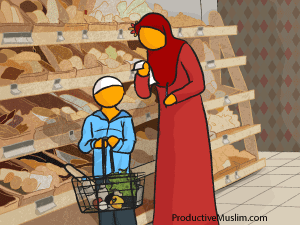
“Ali, please come downstairs and eat”, calls Haleema, his mother, for the third time. “In a minute MUM, I’m busy, you’re so difficult.. gosh.. just leave me alone!” followed with a loud slam of the door.
How many of us are guilty of this? It may not be the exact same words, but in some way we have all disrespected our parents, which they certainly do not deserve. Today’s youth have lost respect for their parents who worked so hard to raise them. It has become the “norm” to scream at our mothers. We make derogatory remarks and sometimes pretend like we cannot hear what they’re saying.
Just take a second to step back and reflect: the one who taught you how to walk, eat, speak – you consciously CHOOSE to ignore her?
Yet a mother’s unconditional love is like no other. No matter what her daughter or son says, she will call again. Do you know why? Not because she’s your enemy and out to “get you” or because she’s purposely trying to annoy you. It’s because she genuinely cares. She cares a whole lot, more than anyone will ever care.
When you were younger, she went hungry so you could have a full stomach. She didn’t buy anything for herself so she could spend on your toys, just to see you smile. She nursed you when you were ill, she took every blame for you to hide your faults. So why do you suddenly act like YOU are doing HER a favour by just standing in her existence? Seriously, are you for real?
Paradise is at the Feet of Mothers
You should instead be treating her like a queen and “kiss the very ground she walks on” for all the favours she’s done for you.
Subhan Allah – I don’t want to sugarcoat the reality because I’ve seen this happen with my own eyes, so don’t take offence to what I say. Unfortunately the truth is more bitter than it’s ever been. I’ve witnessed it – the endless worry and care of mothers for their children and the children’s utter disrespect and disregard for their mothers because, “It’s different now!” and “Ugh, you’ll never understand me”.
Why? Because they were never young so they obviously won’t “get you”?
This injustice is done not only to mothers but fathers too. Sometimes children become so arrogant and enveloped in their selfishness that when their parents speak to them in their native language they cleverly reply with English slang terms in attempt to humiliate their parents. I ask you today to contemplate on this. With the high status Allah (glorified and exalted be He) has given to our parents, do we even pay them an ounce of the value they are worthy of?
Here’s What You Need to Stop Doing
Stop raising your voice
“Say not to them [so much as], ‘uff,’” [Qur'an: Chapter 17, Verse 23]. What a profound statement from the Qur’an. We should not even sigh heavily, let alone raise our voices. When your parents raise their voice at you, 9 out of 10 times they have a very good reason to do so. Don’t let shaytan fuel your anger and ego, causing you to react totally inappropriately. Stop, listen, agree and apologise – thereafter rectify your mistake, even if you think you’re right and they’re being unjust.
Stop ignoring them
So you’re out with your friends and suddenly you see a call from “Home”. Automatically you dismiss the call. Why? Don’t want to disturb the good time you’re having with your friends, or are you embarrassed to speak to your mum and dad?Remember when you were five years old, and you decided to throw a tantrum in the middle of a supermarket? Don’t you think you embarrassed your mum then? She didn’t decide to abandon you, did she? Because at the end of the day, you’re her child and no matter what you do, she will never ever be embarrassed of you. You owe a hell of a lot to your parents.So pick up that call, and politely answer their questions. Better yet, call them a few times while you’re out. It won’t kill you – you have countless minutes to spend on your friends. So spare a few minutes on your parents and spare them imagining all sorts of horrific scenarios in their minds when you don’t pick up!
Stop thinking you’re always right
This, for me, is one of the most loathed characteristics. Think about it logically – how much worldly experience do your parents have compared to you? Making sense yet? When discussing things with parents, remember never to reject their opinions. Believe it or not, they were young once and also made mistakes, probably the same mistake you’re about to make now, which is why they are advising against it.As the Romanian proverb goes, “Only the foolish learn from experience; the wise learn from the experience of others.” So take advantage of their knowledge, experience and wisdom that you haven’t developed yet. So next time, instead of rolling your eyes and saying, “Yeah yeah, whatever”, listen – really listen. Take it in and act upon it. You can thank them in the process too.
Here’s What You Need to Start Doing
Start showing some gratitude
This follows on from my last point. It won’t harm you to express a word of gratitude once in a while. After all, they did clean your nappies. Parents have “bad” days too, they’re human too. And they need someone to brighten up their day at times. So be that ray of light at the end of a long day. Say “thank you”, make them smile, hug them, buy them a gift.Do this randomly and they’ll be so pleasantly surprised that the smile you put on their face won’t disappear for a long time. It’s not easy being a parent, and sometimes you think you’ve done it all wrong. By expressing some love, they’ll be reassured that they must have done something right for you to behave in such a way.
Start going out of your way to please them
If anyone on earth deserves this, it’s them. Not your friends or even your spouse, it’s your parents. Allah (glorified and exalted be He) has granted them such a high position; how can you treat them any less? Offer to help out in any way possible. Do extra tasks, massage their feet, drive them around whenever they need, help with the cooking, anything and everything which you would never do for anyone else and have to make an extra effort to do – DO IT.
Start making sincere dua for them
Every child knows that their parents mention them in every dua. Your parents wish nothing but well for you. They pray for your success. It’s time for you to replicate the favour. Pray for their wellbeing, pray for their forgiveness, pray for Jannah for them, and most importantly thank Allah (glorified and exalted be He) for them. Make this a habit in every salah. Before you mention yourself, mention them.
Make Your Parents Proud
Evidently these points are general and there are loads more that could be mentioned, but I’ve just listed the things I have personally observed to be an issue. At the end of the day, pleasing your parents will please Allah (glorified and exalted be He), there is no one on earth who deserves your mercy and compassion more than your parents.
Do them proud. If they’re happy, you’ll also be happy, and by treating them well you increase your good deeds. Lastly, never ever disrespect them. On that note, I leave you with this verse from the Qur’an:
“And your Lord has decreed that you not worship except Him, and to parents, good treatment. Whether one or both of them reach old age [while] with you, say not to them [so much as], ‘uff,’ [i.e., an expression of irritation or disapproval] and do not repel them but speak to them a noble word. And lower to them the wing of humility out of mercy and say, ‘My Lord, have mercy upon them as they brought me up [when I was] small.’” [Qur'an: Chapter 17, Verses 23-24]
May Allah (glorified and exalted be He) allow us to be kind, compassionate and caring towards our parents and earn their love, not their anger.
About the Author:
A 23-year-old IT consultant by profession but a “Striving Muslimah” by heart. Currently undergoing a career change, Striving Muslimah is pursuing primary teaching with children who are less able. She is an avid baker, a self confessed geek, and a firm believer in the proverb “wherever there is a human in need, there is an opportunity for kindness and to make a difference”.
click here to read the original post
Subscribe to:
Posts (Atom)