Showing posts with label naseeha. Show all posts

Sunday, July 13, 2014

Staying Physically Energized During Ramadan


With Ramadan in the midst of summer this year, we need nothing more than hydration and good eating habits to keep us going. However, Ramadan is not only about omitting food and drink from sunrise to sunset. It’s not about sleeping all day and waking up an hour before sunset to prepare a meal. It’s not about indulging all night and sleeping all day. No, Ramadan is a spiritual car wash for our souls. It’s a time to check in on ourselves, omitting desires, and focusing on what we were initially created for: worshipping Allah subhanahu wa ta`ala (exalted is He).
While we focus on our spiritual upbringing, we also need to focus on our physical well-being. Instead of praying Maghrib and rushing to eat, set your intention to eat to nourish your body so that you can stand and pray. In this case, you make eating an act of worship and get rewarded for it, Allah (swt) willing. Set your intention to eat suhoor (the meal before sunrise) to worship and have energy all day. Set your intention to eat iftar (the meal after sunset) to worship and pray during the night. Now, let me share a few tips on what to

eat to stay hydrated, energized, and motivated all day long.
1)     Eat dates.
    dates
  • I personally don’t question any food that was eaten by the Prophet Muhammad ﷺ (peace be upon him) or recommended by him.
    • Anas Ibn Malik radi Allahu `anhu (may God be pleased with him) narrated: “The messenger of Allah ﷺ  used to break his fast before praying with some fresh dates, but if there were no fresh dates, he had a few dry dates, and if there were no dry dates, he took some mouthfuls of water.” [Sunan Abu Dawud]
  • Fasting all day means facing difficulties reaching the required daily value for many essential vitamins and nutrients. Dates are known to provide many of these nutrients with just a few pieces:
    • Dates have immense health benefits, including high fiber, potassium, magnesium, copper, and B vitamins.
    • Dates are known to regulate blood sugar, weight loss, blood pressure, cancer, and arthritis. Dates also aid in facilitating oxygen to the brain and the formation of healthy skin.
  • Tip: Eat three or more dates at suhoor to give you energy all day. Break your fast on dates and pray Maghrib. This regulates your blood sugar and causes you to not overeat at iftar.
2)     DON’T skip out on suhoor.
  • Yes, it’s 4 a.m. and yes it’s going to be difficult, but my number one piece of advice is don’t skip out on suhoor. The Prophet ﷺ advised us to eat suhoor and promised barakah (blessings) in it. Abu Hurairah (ra) narrated: “The Messenger of Allah ﷺ said: ‘Eat suhoor, for in suhoor there is blessing.’” [Sunan Al- Nasa’i]
  • Eating a meal before sunrise will give you energy to keep going during the long day ahead of you.
  • If you skip out on suhoor, you are putting your body in starvation mode and actually only going to cause yourself to overindulge at iftar.
  • So, EAT SUHOOR!
  • Tip: Eat a light but nutritious, breakfast-like meal:
    • Try a zatar  or cheese pie with some cucumbers. Tomatoes and a cup of fresh-squeezed orange juice are also excellent sources of vitamins and nutrients.
    • Have nutrient-dense whole-grain toast with almond butter, cashew butter, or all-natural peanut butter. Top with berries or banana slices.
    • Try some quinoa with almond milk, raisins, cinnamon, raw honey, and bananas. It will definitely give you fuel for the day.
    • A bowl of steel cut oats or whole grain cereal and organic milk/almond milk are also great.
    • Don’t forget the dates. ;)

3)     Eat hydrating foods like watermelon, cucumbers, citrus fruit, and tomatoes.
    salad
  • It’s not only summer time, but we are fasting 17+ hours. Many of us have work and others are taking summer courses. We are going to lack energy and need as much nutrients as we can get from the food we eat. Hydrating ourselves with water-dense foods will keep our bodies from dehydrating in the heat.
  • Tip: Other foods with high water content include: lettuce, pineapple, berries, citrus fruit, and spinach.
4)     Drink plenty of water between iftar and suhoor
  • Water is the most purifying drink;  it cleans out toxins from your body and prevents you from getting headaches (especially when you’re not drinking or eating all day).
  • Tip: Skip the soda! Drinking soda with your iftar will only make you thirstier, and dehydrate your body more than it already is. Drink water with your meal and keep it at hand throughout the night.  Break your coffee and tea addiction.
  • If possible, regulate your body to get rid of your caffeine addiction before Ramadan starts. If you are drinking 3-4 cups of coffee daily, and on the first day of Ramadan you don’t drink any, you may get headaches and lack energy.
  • Tip: If you really need energy, opt for dates instead. Coffee and tea are known to dehydrate the body even more.
I hope that you find these eating tips helpful! I assure you that making these small changes in your Ramadan and even regular diet, will substantially improve your overall health and fitness.


Click here to read the Original post
 

Monday, April 7, 2014

Tips to Effectively Discipline Your Children

بسم الله الرحمان الرحيم
In the Name of Allah,
the Most Gracious, the Most Merciful.

[Family Life - Part 3] Tips to Effectively Discipline Your Children | Productive Muslim
                                Photo by Tiffany Jill: iquitcountingstock[dot]deviantart[dot]com

This is the third and final piece of a 3-part series on having a productive household. In this section, we will discuss 7 more aspects of a productive household. These will relate to successful ways of disciplining your children more effectively without hitting or shouting.

1. Be Sensitive to Your Child’s Feelings

One of the best ways to avoid future behavioural problems is to be sensitive to your child’s feelings. Let your child know you understand how he feels, even when he has misbehaved. For example, If Abdullah comes home with a notice from school that admonishes him for speaking disrespectfully to his teacher, listen to his story and frustrations first. Let him know that you understand how he feels. Then later you can kindly follow up with instructions on how he should handle the situation in the future more appropriately. At this time, you can also proceed to dispense whatever penalties you deem suitable.
The most effective penalties are those that are implemented with respect and gentleness. Allah subḥānahu wa ta'āla (glorified and exalted be He) says in Qur’an: “So by mercy from Allah, [O Muhammad], you were lenient with them. And if you had been rude [in speech] and harsh in heart, they would have disbanded from about you. So pardon them and ask forgiveness for them and consult them in the matter.” [Qur’an: Chapter 3, Verse 159]
According to hadith, the Prophet ṣallallāhu 'alayhi wa sallam (peace and blessings of Allāh be upon him) said: “Whoever was given his share of gentleness, then he has been given a share of good. And whoever has been prevented from his share of gentleness, then he has been prevented from his share of good.” [Tirmidhi]

2. Use Positive Reinforcement Often

Seek out situations and behaviours in which you can commend your child. For example, when you notice Abdullah getting along with his younger sibling or completing his homework without being told, let him know how pleased you are. Such as, “Abdullah, thank you for cleaning your room without my reminding you to. Your room looks really nice.”
You will often find that encouragement leads to more successful discipline than criticism. Encouragement makes people feel good about themselves, which leads to further effort. Criticism, on the other hand, leads to feelings of despondency, which results in apathy.

3. Give Your Child Control Periodically

We all have a need to be in control of our lives and to feel important. If you find your child becoming increasingly combative and argumentative, give them a say in what goes on in the house. Make sure you provide your children with the opportunity to make their own decisions every now and then. Also, allow them to be in charge of things around the house. For children who have a stronger desire to be in control than others, grant them the extra responsibility. Consider assigning daily chores to your children. This can give them a sense of belonging and purpose. Use an incentive chart to encourage them to complete their chores on occasions they are reticent.
If your child refuses to take a bath when asked to, try offering him or her options rather than commands. For example, “Abdullah, do you want to take your bath now or in ten minutes?” Occasionally, let your child decide what dinner will be for the night or where the family should go for their weekend outing.

4. Be Fair When Disciplining

Being unfair or excessively harsh when correcting your child can sometimes lead to your child retaliating in subtle ways, such as venting his anger on younger siblings or embarrassing you in front of friends and family with disruptive behaviour.
According to hadith, the Prophet ṣallallāhu 'alayhi wa sallam (peace and blessings of Allāh be upon him) said: “Treat your children fairly, treat your children fairly.” [Nasa’i]
Another hadith states that the Prophet ṣallallāhu 'alayhi wa sallam (peace and blessings of Allāh be upon him) said: “Act equally between your children; Act equally between your sons.” [Abu Dawud]
Everyone wants to feel respected and appreciated. Treating your children justly can alleviate a host of discipline problems and helps to make them feel valued. A person who feels valued has the self-respect to adhere to established rules.
If you find you have disciplined excessively or unjustly, let your child know you are sorry. Parents can apologise too. This can teach your child that mistakes in judgment can be corrected. It can also help your child to swallow his resentful feelings that lead to excessively unruly behaviour.

5. Be Conscious of Your Stress Level

If you have been under extra stress lately, realise that your frustrations with your child might be related more to how you are feeling rather than your child’s actual misbehaviour. When you are under added stress, you tend to have less patience. You might snap at your children for things you would not ordinarily scold them about. During these periods, acknowledge your heightened tension and then decrease your stress by retreating to your room for rest. You can also relax by involving yourself in special personal time such as reading an enjoyable book or listening to Qur’an.

6. Be Aware of Your Child’s Stress Level

A child that is stressed out is less likely to be cooperative and more inclined to moodiness. Both of these actions can lead to problem behaviours. If you notice that your child is experiencing added stress, focus on relieving the stress by determining what is upsetting him or her and doing what you can to help alleviate the problems. During these stressful periods, within reason, try to overlook negligible behaviours. Focus more on finding solutions rather than punishment.
Also, keep in mind that one of the best ways of alleviating your child’s stress level is by showing your love and affection.
According to hadith, the Prophet ṣallallāhu 'alayhi wa sallam (peace and blessings of Allāh be upon him) was very loving with his grandchildren. Aisha raḍyAllāhu 'anha (may Allāh be pleased with her) reported, “Some Bedouin people came to the Prophet ṣallallāhu 'alayhi wa sallam (peace and blessings of Allāh be upon him) and said: ‘Do you kiss your children?’ He said: ‘Yes’. He said: ‘But we, by Allah, never kiss (our children)’. The Prophet ṣallallāhu 'alayhi wa sallam (peace and blessings of Allāh be upon him) said: ‘What can I do if Allah has taken away mercy from you?’” [Ibn Majah]
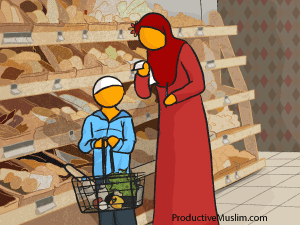
7. Determine if Your Child is Seeking Attention

Some children will attempt to seek attention in any way they can, even if it is through improper behaviour. Try to spend more time with your child if you know you have been a bit slack lately. Simply listening more and giving your full attention when he or she is talking to you can be a start. But also remember to put aside special time during the day or week to spend with your child. Make it a habit of playing games every Friday or going on outings every Saturday. Arrange a schedule that will be suitable for all family members.
The Prophet ṣallallāhu 'alayhi wa sallam (peace and blessings of Allāh be upon him) was known to spend fun time with his family. According to hadith, Aisha raḍyAllāhu 'anha (may Allāh be pleased with her) said that while she was on a journey along with the Messenger of Allah ṣallallāhu 'alayhi wa sallam (peace and blessings of Allāh be upon him), “I had a race with him (the Prophet ) and I outstripped him on my feet. When I became fleshy, (again) I had a race with him (the Prophet) and he outstripped me. He said: This is for that outstripping.”  [Abu Dawud]
Establishing effective discipline techniques in your home can help parents achieve one of the most difficult yet most critical roles of a parent — that of the proper training of their children and in turn, a productive household.
Developing a productive household is an important aspect of establishing a healthy and productive society. Begin striving to improve your household habits in the manner mentioned in the three parts of this series. Be generous and kind, be patient with shortcomings, be committed to an intact family, and most important of all, remain faithful and dedicated to pleasing Your Lord. In sha Allah, you will see a more positive and fruitful home in the future.
If these tips have helped or if you have some more tips to share, let us know in the comments below!
 Read the other parts: (Part 1 | Part 2)


About the Author:
Grandma Jeddah is the mother of 11 children and 10 grandchildren. She has taught at an Islamic School in Los Angeles, California for over thirty years. She is the author of Discipline without Disrespecting: Discover the Hidden Secrets of How to Effectively Discipline Your Muslim Child– And Keep Your Peace of Mind While at It. To order her e-book or subscribe to her free newsletter, visit her website at: www.grandmajeddah.com

Click here to read the original post

Friday, September 6, 2013

The Forgotten Blessing: Giving Your Parents the Proper Treatment They Deserve

 بسم الله الرحمان الرحيم
 In the Name of Allah,
the Most Gracious, the Most Merciful.


Striving Muslimah


“Ali, please come downstairs and eat”, calls Haleema, his mother, for the third time. “In a minute MUM, I’m busy, you’re so difficult.. gosh.. just leave me alone!” followed with a loud slam of the door.

How many of us are guilty of this? It may not be the exact same words, but in some way we have all disrespected our parents, which they certainly do not deserve. Today’s youth have lost respect for their parents who worked so hard to raise them. It has become the “norm” to scream at our mothers. We make derogatory remarks and sometimes pretend like we cannot hear what they’re saying.

Just take a second to step back and reflect: the one who taught you how to walk, eat, speak – you consciously CHOOSE to ignore her?

Yet a mother’s unconditional love is like no other. No matter what her daughter or son says, she will call again. Do you know why? Not because she’s your enemy and out to “get you” or because she’s purposely trying to annoy you. It’s because she genuinely cares. She cares a whole lot, more than anyone will ever care.

When you were younger, she went hungry so you could have a full stomach. She didn’t buy anything for herself so she could spend on your toys, just to see you smile. She nursed you when you were ill, she took every blame for you to hide your faults. So why do you suddenly act like YOU are doing HER a favour by just standing in her existence? Seriously, are you for real?

Paradise is at the Feet of Mothers

You should instead be treating her like a queen and “kiss the very ground she walks on” for all the favours she’s done for you.

Subhan Allah – I don’t want to sugarcoat the reality because I’ve seen this happen with my own eyes, so don’t take offence to what I say. Unfortunately the truth is more bitter than it’s ever been. I’ve witnessed it – the endless worry and care of mothers for their children and the children’s utter disrespect and disregard for their mothers because, “It’s different now!” and “Ugh, you’ll never understand me”.

Why? Because they were never young so they obviously won’t “get you”?

This injustice is done not only to mothers but fathers too. Sometimes children become so arrogant and enveloped in their selfishness that when their parents speak to them in their native language they cleverly reply with English slang terms in attempt to humiliate their parents. I ask you today to contemplate on this. With the high status Allah (glorified and exalted be He) has given to our parents, do we even pay them an ounce of the value they are worthy of?

Here’s What You Need to Stop Doing 


Stop raising your voice
“Say not to them [so much as], ‘uff,’” [Qur'an: Chapter 17, Verse 23]. What a profound statement from the Qur’an. We should not even sigh heavily, let alone raise our voices. When your parents raise their voice at you, 9 out of 10 times they have a very good reason to do so. Don’t let shaytan fuel your anger and ego, causing you to react totally inappropriately. Stop, listen, agree and apologise – thereafter rectify your mistake, even if you think you’re right and they’re being unjust.

Stop ignoring them
 So you’re out with your friends and suddenly you see a call from “Home”. Automatically you dismiss the call. Why? Don’t want to disturb the good time you’re having with your friends, or are you embarrassed to speak to your mum and dad?Remember when you were five years old, and you decided to throw a tantrum in the middle of a supermarket? Don’t you think you embarrassed your mum then? She didn’t decide to abandon you, did she? Because at the end of the day, you’re her child and no matter what you do, she will never ever be embarrassed of you. You owe a hell of a lot to your parents.So pick up that call, and politely answer their questions. Better yet, call them a few times while you’re out. It won’t kill you – you have countless minutes to spend on your friends. So spare a few minutes on your parents and spare them imagining all sorts of horrific scenarios in their minds when you don’t pick up!

Stop thinking you’re always right
 This, for me, is one of the most loathed characteristics. Think about it logically – how much worldly experience do your parents have compared to you? Making sense yet? When discussing things with parents, remember never to reject their opinions. Believe it or not, they were young once and also made mistakes, probably the same mistake you’re about to make now, which is why they are advising against it.As the Romanian proverb goes, “Only the foolish learn from experience; the wise learn from the experience of others.” So take advantage of their knowledge, experience and wisdom that you haven’t developed yet. So next time, instead of rolling your eyes and saying, “Yeah yeah, whatever”, listen – really listen. Take it in and act upon it. You can thank them in the process too.

Here’s What You Need to Start Doing 

Start showing some gratitude
This follows on from my last point. It won’t harm you to express a word of gratitude once in a while. After all, they did clean your nappies. Parents have “bad” days too, they’re human too. And they need someone to brighten up their day at times. So be that ray of light at the end of a long day. Say “thank you”, make them smile, hug them, buy them a gift.Do this randomly and they’ll be so pleasantly surprised that the smile you put on their face won’t disappear for a long time. It’s not easy being a parent, and sometimes you think you’ve done it all wrong. By expressing some love, they’ll be reassured that they must have done something right for you to behave in such a way.

Start going out of your way to please them
If anyone on earth deserves this, it’s them. Not your friends or even your spouse, it’s your parents. Allah (glorified and exalted be He) has granted them such a high position; how can you treat them any less? Offer to help out in any way possible. Do extra tasks, massage their feet, drive them around whenever they need, help with the cooking, anything and everything which you would never do for anyone else and have to make an extra effort to do – DO IT.

Start making sincere dua for them
Every child knows that their parents mention them in every dua. Your parents wish nothing but well for you. They pray for your success. It’s time for you to replicate the favour. Pray for their wellbeing, pray for their forgiveness, pray for Jannah for them, and most importantly thank Allah (glorified and exalted be He) for them. Make this a habit in every salah. Before you mention yourself, mention them.

Make Your Parents Proud

Evidently these points are general and there are loads more that could be mentioned, but I’ve just listed the things I have personally observed to be an issue. At the end of the day, pleasing your parents will please Allah (glorified and exalted be He), there is no one on earth who deserves your mercy and compassion more than your parents.

Do them proud. If they’re happy, you’ll also be happy, and by treating them well you increase your good deeds. Lastly, never ever disrespect them. On that note, I leave you with this verse from the Qur’an:

“And your Lord has decreed that you not worship except Him, and to parents, good treatment. Whether one or both of them reach old age [while] with you, say not to them [so much as], ‘uff,’ [i.e., an expression of irritation or disapproval] and do not repel them but speak to them a noble word. And lower to them the wing of humility out of mercy and say, ‘My Lord, have mercy upon them as they brought me up [when I was] small.’” [Qur'an: Chapter 17, Verses 23-24]

May Allah (glorified and exalted be He) allow us to be kind, compassionate and caring towards our parents and earn their love, not their anger.


About the Author:

A 23-year-old IT consultant by profession but a “Striving Muslimah” by heart. Currently undergoing a career change, Striving Muslimah is pursuing primary teaching with children who are less able. She is an avid baker, a self confessed geek, and a firm believer in the proverb “wherever there is a human in need, there is an opportunity for kindness and to make a difference”.

click here to read the original post


Tuesday, June 11, 2013

Mothers behind the Stars


Mothers Behind the Stars
By Mufti Muhammad Ibn Adam al-Kawthari

In this lecture Shaykh talks about the role of a Mother in the upbringing of
her children. Indeed "behind every successful man, is the hand of a woman",
if we look at the great scholars of the past their mothers play a very
important role.

Tuesday, May 28, 2013

Sibling Rivalry

بسم الله الرحمان الرحيم
In the Name of Allah,
the Most Gracious, Most Merciful.


by Hazrat Maulana Yunus Patel Saheb (rahmatullah alayh)

Sibling Rivalry is a common scenario in almost every home. Arguments and fights are
everyday occurrences amongst brothers and sisters – to the extent that arguments often
lead to physical fighting.

This kind of response is very much against the disposition of a noble person, let alone a Muslim.

We need to learn to implement the noble character of Rasulullah (sallallahu alaihi wasallam)
in our dealings with all – including siblings. It must not be that “we give as good as we get”;
rather we overlook, forgive and show to them, beautiful, dignified conduct.

If we have knowledge of Deen, then this is the setting which tests our practical expression
of that ilm (knowledge) and akhlaaq (character). We either give into nafs and Shaytaan and
show our brothers, sisters and parents that we are like cats and dogs fighting – and are closer
to being animals than humans, or we rise above the indiscretions of our family members,
adopting noble character and speech, and practicing on the ayat:

“The good deed and the evil deed cannot be equal.
Repel (the evil) with that which is better (to be 
patient, forgive, etc.), then verily, he between whom
and you there was enmity, (will become) as though 
he was a close friend.”
                                                                                 
[Surah Fussilaat 41: 34] 
 
Rasulullah(sallallahu alaihi wasallam) had set a beautiful and perfect precedent in teaching
and moulding his two grandsons, Hasan and Husain(radiyallahu anhum).

Rasulullah(sallallahu alaihi wasallam)taught them to respect and love each other. He taught
them that the younger of them should serve the elder, due to the elder sibling deserving
respect. …Khidmat (serving) naturally creates muhabbat(love) and how perfect a
prescription this is for all brothers and sisters, in so far as creating a peaceful and happy
environment at home. This is why we find in the lives of these two grandsons, that
Hazrat Husain (radiyallahu anhu) used to respect Hazrat Hasan(radiyallahu anhu) and
even carry out his requests willingly.

Of course, in the light of the above, the older brother or sister should not think that he or
she can just demand, dictate and nag. If we are older, we have a responsibility to set an
example, worthy of our siblings to follow. There has to be courtesy, mercy, compassion
and love for the younger siblings.A balance needs to be created – where there is humility
on both sides.SayyidinaHasan(radiyallahu anhu) showed great love and compassion for
Sayyidina Husain (radiyallahu anhu).

If either one has to advise the other with regard to something – for example, food, clothing,
room, studies, salaah, etc. then it should be said once only and politely. Thereafter, leave it
to the parents or teachers to solve the problem.

If every sibling were to emulate the grandsons of Rasulullah (sallallahu alaihi wasallam), then
there would be no bickering, quarreling and fighting. Home will be a haven and all parents
will be at peace – with no complaints against their children.

May Allah Ta’ala grant us all the understanding and the taufeeq of practicing.

Saturday, May 4, 2013

When Spouses Curse ....

بسم الله الرحمان الرحيم
In the Name of Allah,
the Most Gracious, the Most Merciful.


by Hazrat Maulana Yunus Patel Saheb (rahmatullah alayh)

A husband complained that he was always angry with his wife, and they continuously argued.

…There are so many such cases : If it is not the husband complaining of his wife, it is the
wife complaining of her husband.

In this case, having been informed of the weaknesses of his wife, which are common to
other women as well, I said: ‘I agree with you that there are weaknesses in women.
However, there are also weaknesses in men. …Moreover, your anger is for worldly
reasons. You are cursing your wife and inviting that same curse upon yourself...’

I then explained to him: ‘When you curse your wife on her defiance, non-compliance
or her indifference to your rights, then Allah Ta’ala’s azaab[1] descends upon her. When
that punishment reaches her, she will not be the only one who will suffer. As her husband,
you too suffer. If she is afflicted with illness or meets up with some accident, the burden of
expense falls upon you, as the husband. You will have to take care of her, and will also find
difficulty in that she will not be able to see to you and the children, and the maintenance of
the home, etc. And if she has to curse you, she too will find herself in a situation of trial
and difficulty...’

There are those women who have the bad habit of cursing their husbands and children –
and generally this is due to impatience or frustration. Instead of turning to Allah Ta’ala
and making Du’aa, they utter such words, which sometimes finds acceptance in the heavens,
but becomes a source of great regret.

It is due to this tendency of cursing and being ungrateful to spouses that 
Rasulullah صلى الله عليه وسلم directed women towards giving charity and 
seeking forgiveness.

Thus, when Allah Ta’ala punishes the husband or the child, then the wife or mother is left
lamenting her plight.

It may be that Allah Ta’ala accepts her curse, and in a fit of anger the husband divorces the
wife. He loses his wife and children and she is left in dire circumstances as a divorcee; or it
may be that Allah Ta’ala accepts the curse, and as such his entire business collapses. Then
poverty becomes the lot of not just the husband, but also the wife who cursed, and the
children. …There are so many ways that curses are Divinely accepted.

Alhamdulillah, the husband explained the above to his wife and they both agreed that
arguing and cursing was not the solution.

Arguments are the cause of great satisfaction and joy to shaytaan, whose great effort is
to destroy marriages. Arguments, in fact, indicate to shaytaan’s presence in our homes.
It is the stepping stone to enmity between husband and wife, and can easily end up with 
divorce, a broken home and many other problems.

Who  does  not want a happy  marriage?  Who does not  want  Sukoon (tranquility) in
marriage? ...  However, to achieve this, some effort has to be made. We just have to train
ourselves to adopt Hilm (tolerance) and Sabr (patience) at times, and learn to curb the
tendency to argue and fight – which is otherwise common even for the most petty reasons.

If we can all keep before us the following Hadeeth and have Yaqeen and conviction on the
words of Rasulullah صلى الله عليه وسلم, many arguments would not even surface and there
would be peace and tranquility:  “I guarantee a house in the middle of Paradise to 
the one who forsakes argument even when he is in the right.’

[1] Azaab : punishment

Click here to read original post

Saturday, March 30, 2013

The Three Golden Rules of Child Rearing

بسم الله الرحمان الرحيم
In the Name of Allah,
the Most Gracious,the Most Merciful.


As far as the sphere of Shari'ah's influence is concerned, it is all
encompassing. It has laid bare all the beneficial and the detrimental
things of this world and the hereafter. There is not a single facet of
life which the Qur'an and Sunnah has not explained in detail or at least
in principal. whether it is cardinal beliefs or devotions, inter-related
dealings, social life or moral character, Islam fully embraces these
five branches. The pages of the Qur'an and Hadith are replete with
their teachings.

However, it is not possible to instruct young children or beginners
in the details of these teachings. In fact, it is not even appropriate
to teach them all the details at the beginning of their Qur'anic lessons.
Therefore, my humble opinion is that instead of going into lengthy
discussions, every mother should focus her attention mainly on
three things during the early stages of the child's life. Together with
their Quran'ic lessons, emphasise these three  points and cultivate
them within the children. Pinning our expectations on the mercy of
Allah Ta'ala, we hope that even if you are particular about these three
basic fundamentals only, their lives will undergo a remarkable imani
influence. This in turn will simplify practicing on the other branches
of din, InshaAllah.

The three fundamentals are :

#    Devotion to fard salaah
#    Total abstention from lies
#    The habit of serving others

(1) Devotion to the Fard Salah

Who does not know that salaah is the basic fundamental of Islam and
that it is the most important obligation from amongst all the other
obligations? The  Noble Qur'an is explicit in its declaration : ''Verily
salaah prevents shamelessness and vileness.''

Therefore, when the child, boy or girl, reaches the age of seven, be very
vigilant and ensure that they are performing their obligatory salaah. Girls
are required to perform their salaah at home whilst boys and men are
commanded to perform their salaah with the congregation. So every child
should be practically instructed about the performance of salaah. They
should be taught the surahs and other du'as of salaah. Keep a watchful eye
on them and make sure they are performing their fard salaah. Do not be
lenient in any aspect of salaah. If a child is not punctual with salaah with
jam'at (congregation), then somehow or the other get him to perform his
salaah consistently with the jam'at.

The best and most tried and tested remedy to achieve this goal is to engage
in t'alim (i.e. daily recital before all family members) of the book compiled
by Sheikhul-Hadith Hadrat Maulana Zakariyya Sahib entitled 'Fadail-e-Salaah'.
From the age of seven, ask the children to write and then memorize these
Ahadith. You may also make them compete with one another in their leisure
time. For example, you may challenge them to write out ten Ahadith and then
twenty and then thirty and so forth. Also, there are forty Ahadith on page 20.
Make your children memorize them and periodically all of you should sit
together and listen to one of them reciting these Ahadith from memory.
Reward the child who memorizes all forty Ahadith.

(2) Total abstention from lies

The second important factor is to cultivate the habit of speaking the truth at
all times and at all costs do not ever tolerate any form of falsehood.

Lying is not only a major sin but it is also a root of other evils. It is a cause
for a number of other sins. So cultivate abhorrence for lies within the children.
Develop the habit of speaking the truth at all times and ensure that they refrain
from falsehood. This will ensure that they automatically abstain from a number
of other sins as well. This is why Rasulullahصلى الله عليه وسلم declared: ''Refrain
from lies as lies leads to immorality and immorality paves the way to Hell.''

It is also for this reason that Rasulullahصلى الله عليه وسلم declared lies to be
diametrically opposed to Imaan (belief).

Imam Malikرحمة الله عليه mentions a Hadith: ''Rasulullahصلى الله عليه وسلم was 
once asked : ''Can a believer be cowardly?'' He replied: ''Yes, he can be 
cowardly.''  He was again asked: ''Can a believer be miserly?'' He replied:
''Yes, he can be miserly.''  Rasulullahصلى الله عليه وسلم was asked once again:
''Can a believer be a liar?''  He replied: ''No, a believer cannot be a liar!''

Hence, in order to make them perfect Muslims, children should be stead-
fastly restrained from all  forms of falsehood. On no account should you
yield to any form of their lies. After being found guilty of any misdemeanour,
if the child speaks the truth, whilst considering the circumstances, be a bit
lenient with him when admonishing him or forgive him altogether. However,
if he compounds his misdemeanour with lies, do not be lenient in disciplining
him. In this aspect, the parents as well as the teachers should be fully aware of
their responsibilities.

continued in another post inshaAllah

Ideal Mother
by Moulana Muhammad Hanif 'Abdul Majid


Saturday, March 2, 2013

Naseehat by Maulana Tariq Jameel


Few very beautiful(advices) naseehat by Maulana Tariq Jameel with English
subtitles. For more of Maulana's bayans with English Sub click here

Wednesday, January 30, 2013

Peace of Mind

بسم الله الرمان الرحيم
In the Name of Allah,
the Most Gracious, the Most Merciful.


The ability to do good deeds is also
Granted by Allah

Firstly Allah asked us to do a certain act which is good for us. Then
he gave us the courage to do so. Then He made the way for us to do
that. Finally, he rewards us after we got the benefit of that act too.
This is like granting one blessing after the other.

Satanic Deception

Satan presents a deception to us that by doing a particular sin, its
stimulation will be decreased next time. But this effect is tempo-
rary only. Rather the urge will be stronger in future and out of
control too.


No sin is greater than the
Forgiveness of Allah

If a person does not ask Allah for forgiveness by thinking that his
sins are innumerous and this act wont be fruitful then his thinking
is foolish and he is being trapped by shaitan. Apparently his thinking
is like repentance but as a matter of fact, it reflects his superiority
complex that he has caused such a big damage to the system of Allah
which cant be forgiven by Allah now. Remember that even if the whole
world gets disobedient to Allah, it cant cause any damage to Him or
stop Him from forgiveness.

Repentance of Sin is Essential

If we could observe how vast is forgiveness of Allah, we would never
had been ashamed of thinking our sins as too many to be forgiven by
Allah. Such an ashamed feeling urges us not to be repentful over our
sins, this urge should be avoided as the sins are not greater than the
forgiveness of Allah but enough to mislead us. Example is that of
100 gms of Copper Sulphate or poison which is not greater than a
quintal of its antidote but it is still enough for our stomach.

The Belief which forbids from asking
Allah for Forgiveness, is False

A Mumin (true Muslim) is always worried about his sins unlikely to
a non-Muslim who thinks it like as small as a fly which can be tackled
easily. This means that the sin should not be considered too small to
be ignored over and it should not be taken too big to prevent asking
Allah for forgiveness. So repentance is of the real importance and
not the belief of considering it small or big sin.   


Whose Company should one adapt

A person having three qualities should be considered worthy of
(keeping the company of Firstly, he should be a Faqeeh (knowing
the ins and outs of fundamentals of religion). Secondly, he should
be a Muhaddis (the one who is having knowledge of Hadith). Thirdly,
he should be a Sufi (having spiritual know how).

How to Develop the Right kind of Love

The easy way to do this is to adapt the company of those who love
Allah. It will yield the effects like a magical stone that turns a piece
of iron into gold when touched.

Forgiveness of Allah is waiting for
opportunities

Firstly we have to muster up a bit courage ourselves then Allah
completes it Himself. Example is that of a kid which staggers
and falls after walking a few steps.

Peace of Mind
A Summary of Sayings of
Hazarat Maulana Ashraf Ali Thanviرحمة الله عليه


Sunday, January 6, 2013

Children and Toys by Hazrat Maulana Yunus Patel Saheb (rahmatullah alayh)


بسم الله الرحمان الرحيم
In the Name of Allah,
the Most Gracious, the Most Merciful.


When a child wants a toy which is of an animate object or a musical
instrument, then gently explain to the child that Allah Ta’ala is displeased
with such a toy, and that the presence of such toys in our homes deprive us
of the presence of the Malaa`ikah (angels) of Rahmah (Mercy).

After having explained this, buy something better, if it is within one’s means,
of the ‘mubaah’ (permissible) category – without being extravagant and wasteful.
Considering the fact that most children have all kinds of animate, musical and
haraam (forbidden) toys, do not let the child feel as if he or she is being deprived
of play. …Make the child happy with Halaal so that he or she will grow up 
loving the beautiful Deen (religion) of Islam.
 
The same applies to children’s clothing and accessories to be found on the market;
many of which have cartoon characters, etc. which would captivate and charm little
children; but which the Shariah[1] does not permit.

Muslims today consider these restrictions as trivial and irrelevant whereas there is
great wisdom in all the ‘Muharramaat’ (prohibitions) of Islam.

In actual fact, one of the reasons why children have nightmares is due to the
photographs that we bring into our homes, the cartoons and other programmes
we allow and encourage them to view, or such clothing and toys that are impermissible…
Sometimes the room walls are plastered with cartoon characters, huge teddy bears,
dolls and stuffed animals are all around the room, which result in frightful dreams.

…There are angels that are deputed to look after our children, but these angels do
not enter that home where there are pictures of animate objects. This deprives our
children of the presence and protection of the angels, who also play with babies.

Rasulullah (1) said : “Angels do not enter a house in which there is a dog or a picture.”
(Sahih Muslim)
 
We claim that we are Believers in Allah Ta’ala and His Rasul (1).
If the claim is true and sincere, then it is not acceptable that as 
Believers in Allah Ta’ala and His Rasul (1), we debate, argue or
reject what are clear injunctions of Shariah. The person who does
so, has clearly strayed from the right path…
 
 “It is not fitting for a Believer, man or woman, when a matter has
 been decided by Allah and His Apostle, to have any option about
 their decision : If anyone disobeys Allah and His Apostle, 
 he is indeed on a clearly wrong path.”
[Surah Ahzaab 33 : 36]

 Allah Ta’ala mentions the response of His sincere servants: 
“The answer of the Believers, when summoned to Allah and His Rasul,
 in order that he may judge between them is not other than this :
 They say, ‘We hear and we obey.’ It is such as these who will attain felicity.

It is such as these who obey Allah and His Rasul, and fear Allah and
do right, that will win (in the end).”
[Surah Noor 24 : 51 / 52]


[1] Shariah : Code of Islamic Law

click here to view original post
 

Tuesday, January 1, 2013

Show Our Children The Road To The Masjid-They Will Connect To Allah!

بسم الله الرحمان الرحيم

In the Name of Allah,
the Most Gracious, the Most Merciful 


Show Our Children The Road To The Masjid-
They Will Connect To Allah!

Thought provoking points by Mufti Husain Kadodia (Hafidhahullah) in his Jumu’ah discourse:


Parents generally worry about the worldly well being of their children and make great sacrifices for their worldly comfort. The actual concern of parents should be about their death with Iman and their wellbeing in the hereafter and to nuture them accordingly.


Umar bin Abdul Aziz Rahimahullah was a great Khalifa of the time. He left a very small estate for his children. When he was asked about the worldly comforts of his children, he said “I thought my children to obey Allah.” Over a period of time, the very children of Umar bin Abdul Aziz became very wealthy and used to spend large amounts of money in the path of Allah. On the contrary, Hisham bin Abdul Malik Rahimahullah who was also a Khalifa left a large estate for his children. Over a period of time his children became paupers and people saw them begging on the streets of Baghdad.


When we teach our children Allah consciousness, that will be useful to them in this world and the hereafter. If we give our children all the comforts of the world besides Deen, the very comforts will be a means of their destruction in this world and the hereafter. It is holiday time. Everyone is gone on relaxed mode and tend to drop their guards. We know the fitna of drugs, drinking, and intermingling in the outside world.


It is our responsibility to guard our children and save them from falling prey to the evils around us. Show our children the road to the Masjid- they will connect to Allah.

- Points noted by Mufti Ebrahim Desai (Hafidhahullah)

Darul Iftaa 


Saturday, December 15, 2012

Sunday, December 2, 2012

Love of Children

بسم الله الرحمان الرحيم
In the Name of Allah,
the Most Gracious, the Most Merciful.


Love of Children is Natural to Parents

It is natural for parents to love their children, to look after them
and to be kind and compassionate to them. Without this motivation
human beings could have been wiped off the face of the earth. The
Noble Qur'an has categorised children as the adornment of the world
(Surah 18: 46). Children are a great blessing of Allah Ta'ala for which
we must thank Him (Surah 17:6). Further, if children are pious and
Allah-fearing, then they are the delight of the eyes (Surah 25:76).

 Poets have composed very high calibre poetry on the subject of love
for children; these are very moving and heart-warming and brim with
sentiment and feeling. The poetry of Umayyah bin Abis Sault, Abu Bakr
Tarsuu-see, and Ustaadh Umar Bahaa-ul-Amii-rii, are very touching and
highlight the love and compassion innate in parents. The result of the
love and compassion that Allah Ta'ala, has put into the hearts of the
parents ensures that children are properly trained and that their needs
are met.

Love of Children and being
affectionate to them is a divine gift

Love of children, affection and tender and kind feeling for them are unique
sentiments. They are a determining factor in their guidance and training,
care and nourishment. One who is bereft of mercy has the characteristics
of a surly, stone-hearted, cruel person. Such attributes have an adverse affect
on children; they tend to become lost in the deep maze of ignorance, villainy
and wretchedness. Therefore, Islam urges us to develop the sentiments of
love and mercy. It warns us against being deficient in these qualities.

A person was embracing his child. Rasulullahصلى الله عليه وسلم ,asked him, ''Do
you feel compassion for the child?''

''Yes, I do'', was the polite reply.
Heصلى الله عليه وسلم said, ''Allah is merciful to you more than you are to the
child. He is the most Merciful (of those who show mercy).''

Our beloved Nabiصلى الله عليه وسلم , severely admonished those who were not
merciful to their children.

Once, when heصلى الله عليه وسلم kissed Hassan bin Aliرضى الله عنهما, someone
observed,''I have ten children and I have never shown love to any of them.''
Heصلى الله عليه وسلم looked at the speaker with astonishment and said, ''He
who is not merciful will not be shown any mercy.''
                                                                                      (Bukhari)

When a woman visited Aishaرضى الله عنها she gave the woman three dates.
The woman gave her two sons a date each and kept one for herself. Both
the boys ate their share and then looked towards their mother with expec-
tant eyes for more. She halved the date that she kept for herself and gave
them a piece each. When Aishaرضى الله عنها , related this to Rasulullahصلى الله عليه وسلم
he said, ''Why does this amaze you? Her tenderness towards her children
has earned her the mercy of Allah Ta'ala.''     
                                                                                 (Bukhari)

Rasulullahصلى الله عليه وسلم was very soft-hearted. His grandson was at the
point of death; he took him in his lap and tears rolled down his eyes. Sa'd
رضى الله عنه asked, O Rasul of Allah(صلى الله عليه وسلم)! What's the matter?''

He said: ''This is the mercy of Allah that he has put into the hearts pf men.''

In another version : ''Of His bondsmen. Allah Ta'ala, puts mercy into the
heart of whom He will. Allah Ta'ala, is merciful to those of His bondsmen
who are merciful to others.'' 
                                                              (Bukhari and Muslim)

Bringing up Children in Islam by
Moulana Habiibullaah Mukhtaar  


Tuesday, October 16, 2012

Perfect Days for Perfect Ibaadah

بسم الله الرحمان الرحيم
In the Name of Allah,
the Most Gracious, the Most Merciful.


Alhamdulillah......the blessed days are here one more time !
The glorious days when rewards are multiplied many times, and sins
are forgiven much more...
the days in which Allah gives us yet another change to worship Him,
to ask for forgiveness and correct our faults and make up for our
shortcomings...
the blessed days that the Sahabah waited for and prayed for...
the beautiful days in which they strived long and hard in worship,
until they could do no more....
What are these magnificent days?
These blessed days are the first ten days of Dhul-Hijjah.
Just like the last ten nights of Ramadhan are the best ten nights
out of the whole year,
the Ulama tell us that out of the 365 days of the year, these first
ten days of Dhul-Hijjah are the best days of the year and the most
beloved to Allah Ta'ala as they combine acts of worship in a way
unlike any other times. The Prophetصلى الله عليه وسلم testified to that,
Heصلى الله عليه وسلم said : '' There are no days in which righteous
deeds are more beloved to Allah Ta'ala than these ten days.'' The
people asked, ''Not even Jihaad for the sake of Allah?'' Heصلى الله عليه وسلم
said : '' Not even Jihaad for the sake of Allah, except in the case of a
man who went out to fight giving himself and his wealth up for the
cause, and came back with nothing.'' (Bukhari) 

Subahaan Allah wal- Hamdulillah!
What a blessing!
The question is ... what do I do on these magnificent days and how I
can I make the most of this perfect, golden opportunity to earn rewards
and Jannah ?

Obviously Hajj is one of the best deeds that one can do during these ten
days. However for those of us who were not invited to His House this year,
there are still many, good deeds that one can do and earn the Pleasure of
Allah. Some of these are :

1) Fast all nine days and especially fast
 the Day of "Arafah  

The Prophetصلى الله عليه وسلم said : ''Anyone who fasts for one day for 
Allah Ta'ala's pleasure, Allah Ta'ala will keep his face away from the 
(Hell) fire for (a distance covered by a journey of) seventy years.''
                                                                (Bukhari, Muslim)

Just imagine... if you fast these nine days (fasting on the day of Eid is
haraam), how far your distance will be from hell!

The Prophetصلى الله عليه وسلم used to fast on the ninth day of Dhul-Hijjah
and heصلى الله عليه وسلم said : ''Fasting the Day of Arafah (9th Dhul-Hijjah)
is an expiation for (all the sins of) the previous year and an expiation for
(all the sins of) the coming year.''            (Muslim)

2) Do Lots of  Dhikr and Takbeer    

The Prophetصلى الله عليه وسلم said: '' There are no days on which good deeds
are greater or more beloved to Allah than on these ten days, so recite much
Tahleel (saying Laa ilaaha ill Allah), Takbeer (saying Allahu akbar)and Tahmeed
(saying al hamdu Lilllah).''                               (Ahmad-Saheeh)

Ibn Umar and Abu Hurayrahرضى الله عنهما used to go out in the marketplace
during the first ten days of Dhul Hijjah, reciting Takbeer, and the people would
recite Takbeer when they heard them.                  (Bukhari)

Takbeer at this time is a Sunnah that has mostly been forgotten, especially during
the first few days. So say it in the Masjid, in your home, on the street and every 
place where it is permitted to remember Allah. Revive the Sunnah that have been
virtually forgotten and earn great rewards for doing so.
The Prophetصلى الله عليه وسلم said: ''Whoever revives an aspect of my Sunnah that
is forgotten after my death, he will have a reward equivalent to that of the people
who follow him, without it detracting in the least from their reward.'' 
                                                                               (Tirmidhi- a hasan hadith) 

Obviously, men should recite these phrases out loud, and women should recite
them quietly.

3) Stand in Night Prayers 

Remember the virtues of spending the night in prayer, and its sweetness in 
Ramadhan?! Why not revive this beautiful act of worship during these nights
as well? 
Remember, how in the last third of every night, Allah Almighty calls out to us,
His servants:
Is there anyone to invoke Me, so that I may respond to his invocation? Is there
anyone to ask Me, so that I may grant him his request? Is there anyone seeking
My forgiveness, so that I may forgive him?    (Bukhari and Muslim)

Why do we miss this golden opportunity? So, seize the chance Now and expose 
yourself to His Divine Generosity and Mercy, ask Him to forgive you and guide 
you and set things aright. He will surely listen.

4) Make Sincere Repentance    

One of the best and most important things to do during these ten days is to repent
sincerely to Allah and give up all kinds of disobedience and sin right away because
we do not know when we will die, and also because one evil deeds leads to another.

5) Come back to the Qur'aan

It is time now to dust off your copy of the Qur'aan and return to its refuge. Make
it a daily habit, using these 10days the beginning of a strong and beautiful relationship
with it. Read it with meaning, understand it, and then implement it and change your
lives for the better, as much as you can. Remember that reading one letter of the 
Qur'aan earns you 10 rewards. In this way, reading Surat Al-Fatihah, which doesn't
take more than two minutes will give you more than one thousand rewards! This is 
on ordinary days, so what about these magnificent days! Certainly the rewards will
be far greater, InshaAllah.


6) Generally increase in doing All good deeds
  
We should strive in doing more good deeds in general, because good deeds are
beloved by Allah and will bring us closer to Him. So if we are not able to go to
Hajj this year, we should occupy ourselves during these blessed days by 
worshiping Allah, praying extra prayers, reading Qur'aan, remembering Allah,
sending Salaams on the Prophetصلى الله عليه وسلم making dua, giving charity,
honoring our parents, upholding ties of kinship, enjoining what is good and 
forbidding what is evil, and other good deeds and acts of worship.

''So whosoever does good equal to the weight of an atom, shall see it :
And whosoever does evil equal to the weight of an atom, shall see it.''
                                                              (Surah Al-Zalzalah 99: 7-8)

7) Get the reward of Hajj wherever you are   

You may be unable to do Hajj this year, and you may feel sad because you are
deprived of the great reward of Hajj. But you can achieve a similar reward in
whatever place you may be.

The Prophetصلى الله عليه وسلم said: ''Whoever prays Fajr Prayer in congregation,
and then sits and remembers Allah until the sunrises, then (after a while) prays
two rakahs, he will gain a reward equal to that of making perfect Hajj and Umrah''
(He repeated the word ''perfect'' thrice)                       (Tirimizi)
Isn't that easy, Alhamdulillah?

8) Slaughter an animal and distribute the meat      

Ibn Umar said: The Prophetصلى الله عليه وسلم lived inMadinah for 10 years and
every year he slaughtered an animal.''             (Ahmad)

9) Attend Eid Prayers
  
But remember that Eid prayer is a form of worship and we shouldn't be doing
things that are unIslamic (especially) during these times, such as listening to music,
women going out for prayer without proper Hijaab, mixing of men and women, etc.

10) Thank Allah 

One of the biggest forms of worshiping Allah Subhanahu wa Ta'ala is to thank Him,
deeply, sincerely and continuously. After all, it is He who gave every single thing that
is in you, on you or around you. In fact, you wouldn't even be here if it wasn't for the 
Mercy of your Creator. So thank Him for ALL that He gave you, the Islam that He 
gave you, the very life He gave you. And thank Him for the chance that He gives you
 in these ten days, to ask for forgiveness and guidance. 

Alhamdulillah, there is much to be gained in these coming days. So make the most of
this perfect opportunity offered by these invaluable and irreplaceable ten days. Hasten
to do good deeds and appreciate this blessing and make the most of it, striving hard in 
worship.

''And worship your Lord until there comes unto you the certainty (death).''
                                                            (Surah al-Hijr 15:99)


Sacrifice
   
The act of sacrificing the animal in Allah Ta'ala's name is in submission to His will
and if ever required, we shall readily sacrifice even our own life in the way of Allah.

Sacrifice, as practiced by Prophet Muhammadصلى الله عليه وسلم is an essential religious
rite in memory of the sacrifice performed by Prophet Ibrahimعليه السلام. Allah Ta'ala
put Ibrahimعليه السلام to a most difficult trial, the details of which are described in the 
Qur'aan. ''O my lord! Grant me (Ibrahim) a righteous (son)!'' So We gave him the 
good news of a boy ready to suffer and forbear. ''Then when the son reached the 
age to work with him, he said: ''O my son! I see in a vision that I offer you in
sacrifice: Now say what is your view! ''(The son) said: ''O My father! Do as you
are commanded: You will find me if Allah so wills, one praciting patience and
faithfulness!'' So when they had both submitted their wills (to Allah), and he
had made him prostrate on his face (for sacrifice), We called out to him: 
''O Ibrahim! You have already fulfilled the vision!'' Thus indeed do we reward 
those who do right. ''For this was obviously a trial and We ransomed him with
a momentous sacrifice: and We left (this blessing) for him among generations
(to come) in later times: (37 :100-109).

This is the origin of the Islamic precept of sacrifice in fulfillment of Allah's command.
The aim of sacrifice, like all other fundamentals of Islam, is to absorb piety and self
righteousness. It also promotes the spirit of sacrifice for a right cause. To explain its
purpose, Allah says in the Qur'aan. ''It is not their meat, nor their blood, that 
reaches Allah, It is their piety that reaches Allah.'' (22:37)

Prophet Muhammadصلى الله عليه وسلمsaid : ''On the 10th of Dhul-Hijjah, there is no 
better act in the view of Allah than shedding the blood (of slaughtered animals). And
verily sacrifice earns the approbation of Allah even before the drop of blood (of the
slaughtered animal) falls on the ground. Hence you should offer it in good spirit. For
every hair of the sacrificial animal, there is a blessing.''

Click here

How to perform Eid Prayers
Click here